Photographing Humpback Whales in Tonga: Camera Settings and Tips That Work

The first time a humpback mother and calf drift under you in Tonga, most people forget the camera is in their hand. That is fine. It is also why so many whale photos come home as blue water with a blurry fin in the corner. Photographing humpback whales in Tonga is not hard, but it rewards a bit of preparation: the right settings set before you jump, a simple setup you can run without thinking, and good manners in the water. Here is what works.
What the rules mean for your camera
Tonga runs one of the best regulated whale swim programmes in the world. You swim with a licensed guide, in small groups of four at a time, on snorkel only. No scuba near the whales, no touching, no chasing and no flash or strobes. So forget lighting. Everything you shoot is available light, close to the surface, in some of the clearest water in the Pacific. That actually makes life easier. See our breakdown of Tonga whale swim rules for the full list.
Choosing your camera
Action camera. A GoPro, Insta360 or DJI Osmo Action is the best choice for most people. It is wide, light and you can hold it at arm's length without a second thought. Shoot 4K at 60 frames per second, use the wide or linear lens, and pull stills from the video afterwards. A floating hand grip with a wrist strap stops you losing it.
Compact or mirrorless in a housing. If you already shoot underwater, a Sony RX100, an OM System or a full-frame mirrorless camera in a housing gives cleaner files and real control. Use your widest lens behind a dome port: a fisheye or a 16 to 35 mm equivalent. A humpback is 13 to 15 metres long, and even a curious calf fills the frame fast.
Phone in a pouch. It works for the boat and for shallow moments, but touchscreens fail underwater and the lens is not wide enough. Use it on deck, not in the water.
Whatever you choose, photographing humpback whales in Tonga goes better with a camera you already know. Test it in a pool or on a reef before the trip, not on the first whale day.
Camera settings that work
These are good starting points for photographing humpback whales in Tonga on a sunny day near the surface:
- Shutter speed: 1/250 to 1/500 second. Whales look slow, but a tail stroke moves fast, and you are moving too.
- Aperture: f/5.6 to f/8 behind a dome port, so the whole animal stays sharp.
- ISO: auto, capped around 1600. On grey days or deeper in the blue, let it climb.
- Focus: continuous autofocus with a wide area. Do not fiddle with focus points in the water.
- White balance: auto, and shoot RAW so you can fix the blue later. Red filters help below five metres but do little at the surface.
- Burst mode: on. Encounters are short and the best frame is often the third or fourth.
Set everything on the boat before you get in. Once you are in the water, you should only be pressing one button.
Composition: angles and light
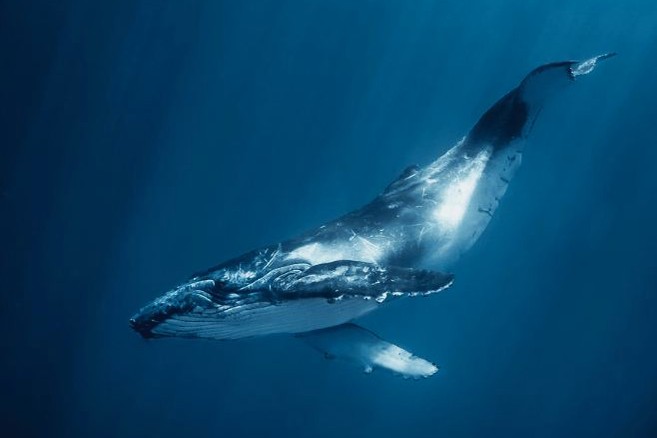
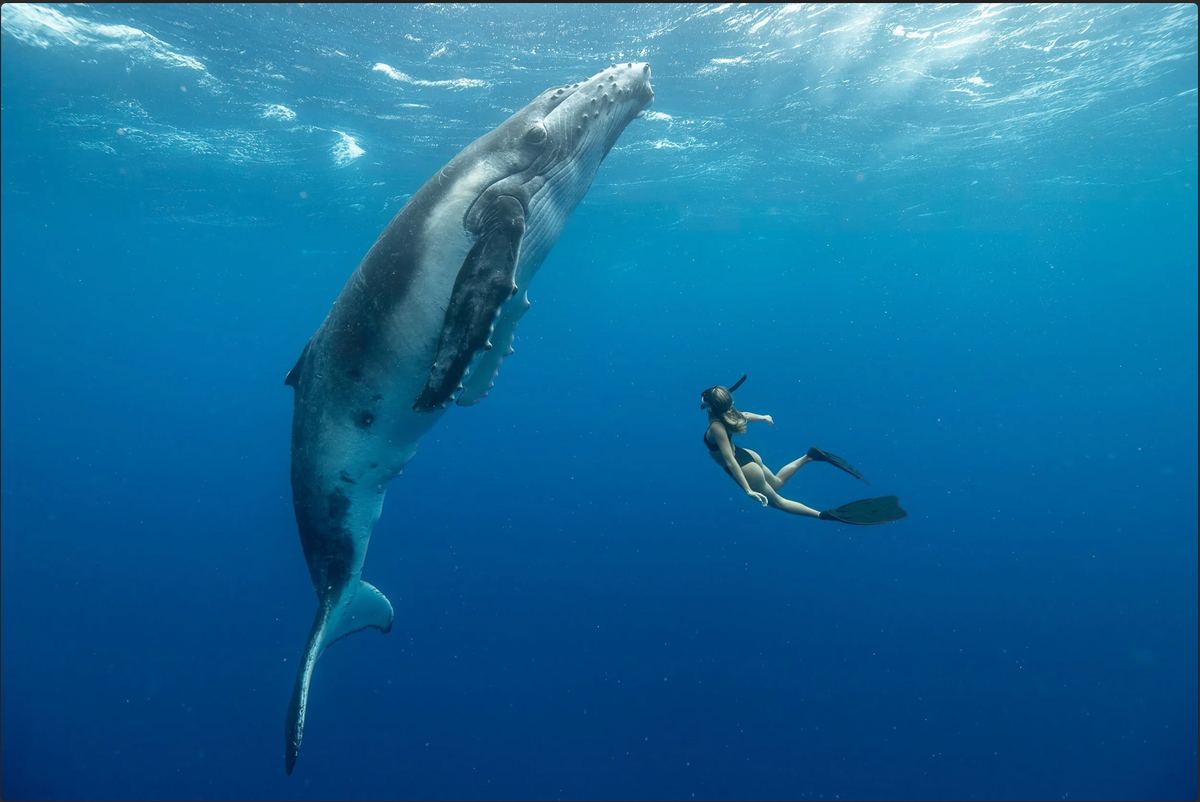
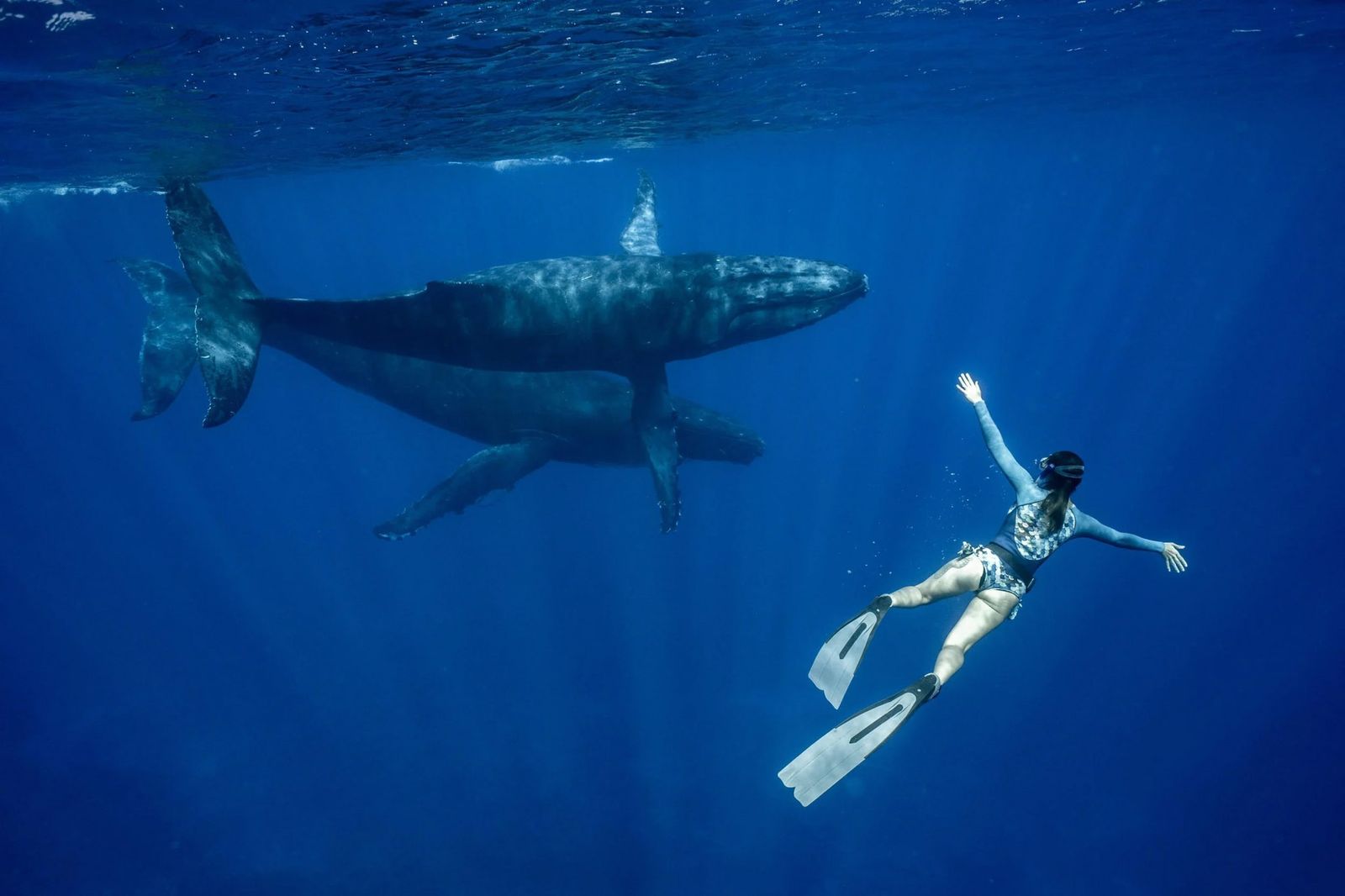
Get low and shoot slightly upwards. A whale against the bright surface reads clearly, with sun rays behind it. Shooting down on a whale from the surface gives you a grey back against dark water, which is the most common disappointing shot.
Look for eye contact. A calf rising to look at you, a mother's eye in the frame, a pectoral fin reaching towards the lens: those are the pictures people keep. Include a snorkeler for scale when you can. It turns a whale photo into a whale story.
Backscatter is the enemy when there is plankton or sand in the water. Keep the sun behind you or to the side, and get closer rather than zooming.
In-water technique
Slide in quietly and stay still. The whale decides how close it comes, and a calm swimmer gets more passes. Kick slowly, keep your arms by your side and hold the camera close to your chest until the whale is in range. Most good frames happen when the animal approaches you, not when you swim towards it.
A short duck dive to two or three metres changes your angle and your photos. Practise it in the hotel pool or on calm reef days. Our guide to a whale swim day hour by hour explains how the rotations work in practice.
Protect the gear. Rinse cameras in fresh water after every day, check housing O-rings each evening and keep spare batteries charged. Bring a small dry bag for the boat, and a microfibre cloth for the dome. Salt spots ruin more photos than bad settings.
Put the camera down sometimes
Here is the honest tip. Some of the best moments in Tonga are not photographed at all. The song of a male humpback buzzing through your chest. A calf rolling over to look at you. Take the shot, then lower the camera and watch. On our trips a photographer records the group, so you can enjoy a few encounters without worrying about the photo.
Swim with us
Our Whales of Tonga expedition is eight days on Tongatapu, with five full whale days on our own private boat and a maximum of eight guests, so the rotations are short and you get more time in the water. Wetsuit, mask and fins are included, and you go home with photos and videos of the group. You will have plenty of chances for photographing humpback whales in Tonga, and plenty of time to just watch. It runs 17 to 24 September 2027, and you can roll straight into our Fiji trip the next day. Applying is free.